FLASH

WATCH THIS BLOG REGULARLY FOR LATEST NEWS ON ONE RANK ONE PENSION & OTHER SERVICE BENEFITS RELATING TO EX-SERVICE PENSIONERS,CENTRAL GOVT PENSIONERS,LIC/GIC PENSIONERS* A UNIQUE BLOG WITH MORE THAN 1 CRORE VIEWERS & 700 FOLLOWERS

FLASH

FlashFLASH**** UNION CABINET APPROVED OROP-3 REVISION FROM 01/07/2024 & CIRCULAR IS LIKELY TO BE ISSUED SOON **** New ***** *UNION CABINET APPROVED OROP REVISION FROM 01/07/2024 & CIRCULAR IS LIKELY TO BE ISSUED SOON
  • New


  • Showing posts sorted by relevance for query Supreme Court. Sort by date Show all posts
    Showing posts sorted by relevance for query Supreme Court. Sort by date Show all posts

    Saturday, 17 September 2022

    Supreme Court grants Centre time till December to implement OROP

     India News

    Published on Sep 16, 2022 06:59 PM IST

    The request for more time was opposed by the original petitioner in the case, Indian Ex Servicemen Movement, which challenged the OROP scheme before the Supreme Court in 2016
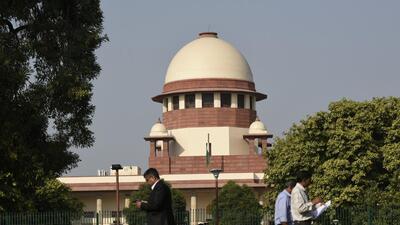
    The Supreme Court gave the Centre three more months, noting that it had made some progress since March 16 when it passed the OROP order. (HT File Photo)
    The Supreme Court gave the Centre three more months, noting that it had made some progress since March 16 when it passed the OROP order. (HT File Photo)
    ByAbraham Thomas

    NEW DELHI: The Supreme Court on Friday allowed the Centre time till December to implement the one rank one pension (OROP) scheme after being told by the government that re-fixation of pension is a “time consuming” process.

    The Centre moved an application for a three-month extension in June, just before the expiry of the deadline set by the Supreme Court in its March 16 ruling that cleared the OROP scheme.

    A bench of justices Dhananjaya Y Chandrachud and Hima Kohli allowed the Centre’s application as it noted that some progress had been made since the passing of the order. The application assured the bench that the government was “taking earnest steps” to comply with the court’s directions which require Cabinet approval.

    It was pointed out that the mandatory inter-ministerial consultations have been completed and a cabinet note drafted. After completing other formalities, the cabinet note will be sent for approval to the Cabinet Secretariat. “After the approval of the Cabinet, various types of pension tables will be required to be prepared by the Controller General of Defence Accounts (CGDA), which is also a time-consuming process,” the Centre said in its application.Additional solicitor general (ASG) N Venkataraman told the court that though three months have passed since the filing of this application, the government still required a further time of three months.

    Acceding to the Centre’s request, the bench was willing to extend the time till December 31 but later modified it by saying three months from today. The three-month period will end by December 15.

    The request for more time was opposed by the original petitioner in the case, Indian Ex Servicemen Movement, which challenged the OROP scheme before the Supreme Court in 2016. Senior advocate Huzefa Ahmadi appearing for the petitioner along with advocate Balaji Srinivasan told the court that the retired armed forces personnel have been deprived of the arrears payable to them under the OROP since its launch on November 7, 2015.

    The scheme envisaged the re-fixation of pension after every five years. This process was to be done in the year 2019 but this wasn’t done since the matter was pending in court.

    In its March judgment, the court said, “We order and direct that in terms of the communication dated November 7, 2015, a re-fixation exercise shall be carried out from July 1, 2019, upon the expiry of five years. Arrears payable to all eligible pensioners of the armed forces shall be computed and paid over accordingly within a period of three months.”

    The challenge to the OROP by the petitioner organization and individual ex-servicemen was on two counts. They wanted an automatic revision of pension instead of a five-year periodic revision and even challenged the arbitrary cut-off of July 1, 2014, for determination of pension which put those who retired prior to this date at a disadvantage.

    The court did not accept the two demands of the petitioners as it felt that the issue fell purely within the policy domain. The government had informed the court that the estimated budget allocation for defence pensions is ₹1,33,825 crores representing 28.39% of the total defence budget estimate of ₹4,71,378 crores for 2020-2021. This does not include the budget for salaries, which is 34.89% of the total defence budget estimates for 2020-2021.

    In its verdict, the court underlined that salaries and pensions accounted for 63% of the defence budget estimates for 2020-2021 and the government was entitled to take into account priorities for modernization of the armed forces and modulate the grant of financial benefits.

    Sunday, 12 February 2012

    JURISDICTION OF CAT & HIGHCOURTS


    CAT , High Court and Supreme Court in respect of Service Matter cases.
    By M. L. Kanaujia, IRSSE, CCE/NE Railway (Rtd.)
    There is lot of speculation going on in respect of appeal against CAT Judgment as to
    whether it would lieto High Court or Supreme Court. The facts are as stated below :
    1. Article 323 A and 232 B of Constitution of India, provides for formation of
    CAT and Other Tribunals, respectively, state as extracted here under :
    1.1 323A. (1) Parliament may, by law, provide for the adjudication or trial by
    administrative tribunals of disputes and complaints with respect to recruitment and
    conditions of service of persons appointed to public services and posts in connection
    with the affairs of the Union or of any State or of any local or other authority within
    the territory of India or under the control of the Government of India or of any
    corporation owned or controlled by the Government.
    (2) A law made under clause (1) may—
    (a) provide for the establishment of an administrative tribunal for the Union and a
    separate administrative tribunal for each State or for two or more States;
    (b) specify the jurisdiction, powers (including the power to punish for contempt)
    and authority which may be exercised by each of the said tribunals;
    (c) provide for the procedure (including provisions as to limitation and rules of
    evidence) to be followed by the said tribunals;
    (d) exclude the jurisdiction of all courts, except the jurisdiction of the Supreme
    Court under article 136, with respect to the disputes or complaints referred to in
    clause(1);
    …………………….
    1,2 323 B. (1) The appropriate Legislature may, by law, provide for the
    adjudication or trial by tribunals of any disputes, complaints, or offences with
    respect to all or any of the matters specified in clause (2) with respect to which such
    Legislature has power to make laws.
    ……………..
    323 B (3) A law made under clause (1) may—
    (a) provide for the establishment of a hierarchy of tribunals;
    (b) specify the jurisdiction, powers (including the power to punish for contempt)
    and authority which may be exercised by each of the said tribunals;
    (c) provide for the procedure (including provisions as to limitation and rules of
    evidence) to be followed by the said tribunals;
    (d) exclude the jurisdiction of all courts, except the jurisdiction of the Supreme
    Court under article 136, with respect to all or any of the matters falling within the
    jurisdiction of the said tribunals;
    2. In compliance of Article 323 A, The CAT Act was passed by the Parliament.
    Para 28 of CAT Act, which excludes the jurisdiction of High Court, states as under
    :
    28. Exclusion of jurisdiction of courts except the Supreme Court –
    On and from the date from which any jurisdiction, powers and authority becomes
    exercisable under this Act by a Tribunal in relation to recruitment and matters
    concerning recruitment to any Service or post or service matters concerning
    members of any Service or persons appointed to any Service or post, [ no court
    except – the Supreme Court ;
    3. Atticle 226 (1) of Constitution, which empowers the High Court to exercise
    jurisdiction, states as under :
    2[226. (1) Notwithstanding anything in article 32 every High Court shall have
    power, throughout the territories in relation to which it exercises jurisdiction, to
    issue to any person or authority, including in appropriate cases, any Government,
    within those territories directions, orders or writs, including ‘[writs in the nature of
    habeas corpus, mandamus, prohibition, quo warranto and certiorari, or any of
    them, for the enforcement of any of the rights conferred by Part III and for any
    other purpose.]
    4. Article 227 (1) of Constitution, which empowers the High Court to exercise
    superintendence all Courts and Tribunals in its jurisdiction, states as under :
    3[(1) Every High Court shall have superintendence over all courts and tribunals
    throughout the territories in relation to which it exercises jurisdiction.]
    5. Seven Judge Constitutional Bench of Hon.ble Supreme Court, in case of L.
    Chandra Kumar vs Union Of India And Others, Equivalent citations: AIR 1997 SC
    1125, 1997 (1) BLJR 735, (1997) 1 CALLT 55 SC : Bench A Ahmadi, M Punchhi, K
    Ramaswamy, S Bharucha, S S Ahmad, K Venkataswami, K Thomas, ORDER : on
    18 March, 1997, A.M. Ahmadi, C.J., in Para 100 of its Judgment, has held as under
    :
    100. In view of the reasoning adopted by us, we hold that Clause 2(d) of Article
    323A and Clause 3(d) of Article 323B, to the extent they exclude the jurisdiction of
    the High Courts and the Supreme Court under Articles 226/227 and 32 of the
    Constitution, are unconstitutional. Section 28 of the Act and the "exclusion of
    jurisdiction" clauses in all other legislations enacted under the aegis of Articles
    323A and 323B would, to the same extent, be unconstitutional. The jurisdiction
    conferred upon the High Courts under Articles 226/227 and upon the Supreme
    Court under Article 32 of the Constitution is part of the inviolable basic structure of
    our Constitution. While this jurisdiction cannot be ousted, other courts and
    Tribunals may perform a supplemental role in discharging the powers conferred by
    Articles 226/227 and 32 of the Constitution. The Tribunals created under Article
    323A and Article 323B of the Constitution are possessed of the competence to test
    the constitutional validity of statutory provisions and rules. All decisions of these
    Tribunals will, however, be subject to scrutiny before a Division Bench of the High
    Court within whose jurisdiction the concerned Tribunal falls. The Tribunals will,
    nevertheless, continue to act like Courts of first instance in respect of the areas of
    law for which they have been constituted. It will not, therefore, be open for litigants
    to directly approach the High Courts even in cases where they question the vires of
    statutory legislations (except where the legislation which creates the particular
    Tribunal is challenged) by overlooking the jurisdiction of the concerned Tribunal.
    Section 5(6) of the Act is valid and constitutional and is to be interpreted in the
    manner we have indicated.
    CONCLUSION :
    Against the Judgment of the CAT, Govt., if it so decides, can go to High
    Court with Writ Petition (Civil) praying for Mandamus (Command to a lower level
    Court i.e. Stay) and Certiorari (Allowing or Disallowing appeal against Judgment
    of a lower level Court).
    xxxxxxxxxxxxxxxxxxxxxxxxxxxxxxxxxxxxxxxxxx

    Friday, 2 March 2012

    LIC PENSIONERS CASE IN SUPREME COURT NEW DEVELOPMENTS

    ·       SUPREME COURT CCP NO. 82-83/2012 IS POSTPONED AND POSTED TO 19 MAR 2012.

    ·      RAJASTHAN HIGH COURT CONTEMPT PETITION IS POSTED TO 27 MAR 2012.

    ·      SUPREME COURT SPECIAL LEAVE PETITION DATE REMAINS AS 16 MAR 2012.

    Contempt Petition in Supreme Court

    SUPREME COURT will take up Contempt Petition today.  We will wait to see what transpires in the Court.


    A version of the earlier Supreme Court proceedings is as given below:-


    Sri Salve requested the Bench to see that Union of India advises LIC to implement the orders.


    The Bench asked Sri Salve the exact amount.


    Sri Salve mentioned that the figure is not readily available.


    The Bench then asked him the amount stated in LIC Board Resolution.


    When Sri Salve replied it was around Rs 52 crores, Bench immediately ordered Sri Salve to ensure LIC deposits that amount within 3 weeks from today in Jaipur HC.


    SC Bench then told the parties that SLP will be pursued after expiry of that period.


    As per this version, Supreme Court has asked LIC to deposit a minimum of Rs.52 crores in the Court whereas LIC has deposited only Rs.4.35 lakhs.

    The order finally passed by the Bench, however, did  not specify the exact amount to be deposited.  It merely notes that the “amount due to the employees” should be deposited.

    It is hoped we will get some clarity in this matter.


    Feb 29, 2012

    SUPREME COURT DEVELOPMENTS


    Monday, 9 October 2023

    Supreme Court stays Justice DC Chaudhary transfer to AFT Kolkata bench; seeks explanation from AFT Chairperson

    The Supreme Court gave the Centre three more months, noting that it had made some progress since March 16 when it passed the OROP order. (HT File Photo)
    The Supreme Court on Monday effectively stayed the transfer of Armed Forces Tribunal (AFT) judicial member Justice Dharam Chand Chaudhary from the principal bench at Chandigarh to the Kolkata bench of the tribunal.

    A Bench of Chief Justice of India DY Chandrachud and Justices JB Pardiwala and Manoj Misra also sought an explanation for the transfer from the AFT Chairperson. It said in its order,

    "We direct that AFT Chairperson in a sealed cover informs the Supreme Court Registrar as to why the transfer was given effect to. Pending further orders Shri Chaudhary need not assume charge in Kolkata. The execution applications being heard in Chandigarh shall not be disposed of without leave of this court."

    It went on to note,

    "Ordinarily, this Court is circumspect in interfering with orders involving transfers. But here a judicial member of AFT has been transferred from Punjab to Kolkata. Bearing in mind the conventional wisdom by which the excercise of power of judicial review is subject to self imposed restraints it is needed to note the grievance of the Bar Association."

    The Court was hearing a plea by the AFT Bar Association at Chandigarh seeking a stay on the transfer order issued by the AFT Chairperson. The Association had alleged that the transfer was a consequence of the strict orders passed by Justice Chaudhary against senior government officials of the Ministry of Defence (MoD).

    The Bar Association has been on indefinite strike to protest the transfer of Justice Chaudhary, which it termed a "direct assault on the independence of the judiciary."

    While transferring Justice Chaudhary, the Chairperson had also transferred to himself the contempt case filed against a Defence Accounts Department officer for failing to implement judgments of the Supreme Court, a case that was slated to be heard by Justice Chaudhary before his transfer.

    After hearing arguments highlighting this chain of events, the Bench noted,

    "Petitioner submits that transfer is mala fide and this needs to be appreciated at a correct stage. At this stage it appears that orders passed since December required Centre to comply. In these circumstances, the transfer would merit close scrutiny. The transfer of a judicial officer in the background where he was dealing with applications seeking compliance of orders for pension to Naib subedars."

    The Bar Association also argued that the control of the Union Defence Ministry over the AFT is contrary to Constitution Bench judgments of the Supreme Court. The Court issued notice in the plea, and directed that the AFT Chairperson's report be submitted before the next date of hearing, on Friday, October 13.

    The AFT Bar Association had penned a strongly-worded letter to the CJI on September 25, and decided to indefinitely abstain from work as a mark of protest against the transfer.

    Thereafter, the AFT bar associations at Jammu and Lucknow also expressed solidarity with the AFT Chandigarh Bar Association in objecting to the transfer of Justice Chaudhary.

    More bar associations have since joined in supporting the AFT Chandigarh Bar Association in its protest.

    These associations include the district bar associations in Chandigarh, Panchkula and Kurukshetra, and the Veteran Air Warrior Association in Haryana.

    The Central Administrative Tribunal (CAT) Bar Association is the latest association to join the protest against the transfer.

    The Bar Assocation had written another letter to the CJI, alleging that Defence Minister of India Rajnath Singh openly admitted to interfering in the transfer of Justice Chaudhary.

    The letter claims that during an event conducted by the Defence Accounts Department on October 1, the Minister openly acknowledged the Ministry's involvement in the transfer just before a contempt case was to be heard.

    The letter also referred to the Minister urging members and the Chairperson of the AFT a few days earlier to slow down case disposal, stating that "justice hurried is justice denied."